If you own a Toyota RAV4, regular tire maintenance is essential for safe handling, comfortable driving, and even tire wear. Toyota RAV4 tire rotation is one of the simplest maintenance tasks you can perform to help your tires wear more evenly and get the most useful life from them.
Tires do not always wear at the same rate on every wheel. Depending on your RAV4’s drivetrain, driving habits, road conditions, and alignment, some tires may experience more wear than others. Rotating the tires at the recommended intervals helps distribute that wear across all four tires and can also help maintain predictable traction and handling.
In this guide, you’ll learn when to rotate Toyota RAV4 tires, the correct tire rotation pattern, recommended intervals, important precautions, and signs that your tires may need attention. We’ll also explain how tire rotation relates to tire pressure, wheel torque, alignment, and overall RAV4 maintenance.
When Should You Rotate Toyota RAV4 Tires?
For most Toyota RAV4 owners, tire rotation should be treated as part of routine maintenance rather than something to wait for until the tires show obvious wear. The exact interval can vary by model year, tire type, drivetrain, driving conditions, and the maintenance schedule specified for your vehicle.
A practical starting point is to check your RAV4 owner’s manual and have the tires inspected regularly. Many drivers choose to rotate their tires at the same time as an oil change or other scheduled service because it makes the maintenance easier to remember. If your RAV4 is driven frequently, carries heavy loads, travels on rough roads, or experiences uneven tire wear, the tires may require more frequent inspection.
Recommended Tire Rotation Timing
| Situation | What to Do |
|---|---|
| Normal everyday driving | Follow the rotation interval in your owner’s manual |
| Frequent highway driving | Inspect tires regularly for uneven wear |
| Rough or damaged roads | Check tread and wear more frequently |
| Heavy loads or towing | Inspect tires more often |
| Uneven tread wear | Have the tires inspected before the next scheduled rotation |
| Steering vibration or pulling | Check tires, alignment, and wheel balance |
| After installing new tires | Confirm the correct rotation pattern with the tire manufacturer or installer |
Don’t Rely Only on Mileage
Mileage is useful for planning maintenance, but it should not be the only factor you consider. Two RAV4s can accumulate the same number of miles while developing very different tire-wear patterns.
For example, frequent stop-and-go driving, aggressive cornering, incorrect tire pressure, poor wheel alignment, and worn suspension components can accelerate uneven wear. Checking the tread and condition of all four tires during routine maintenance can help identify these problems before they become more expensive.
If you notice one tire wearing significantly faster than the others, simply rotating the tires may not solve the underlying problem. A technician should check tire pressure, wheel alignment, wheel balance, suspension components, and the condition of the tires to determine why the wear is occurring.
Check Your RAV4’s Owner’s Manual
Toyota has produced the RAV4 across multiple generations and drivetrain configurations, so maintenance requirements can differ between model years. Before treating a single mileage interval as universal, verify the recommended maintenance information for your specific RAV4.
The owner’s manual is also useful for confirming tire specifications, tire-pressure information, and other maintenance requirements that can affect tire life.
Important: Tire rotation does not replace regular tire inspections. If you see cracks, bulges, exposed cords, severe tread wear, or other visible damage, have the tire professionally inspected rather than continuing to drive until the next rotation interval.
Toyota RAV4 Tire Rotation Pattern
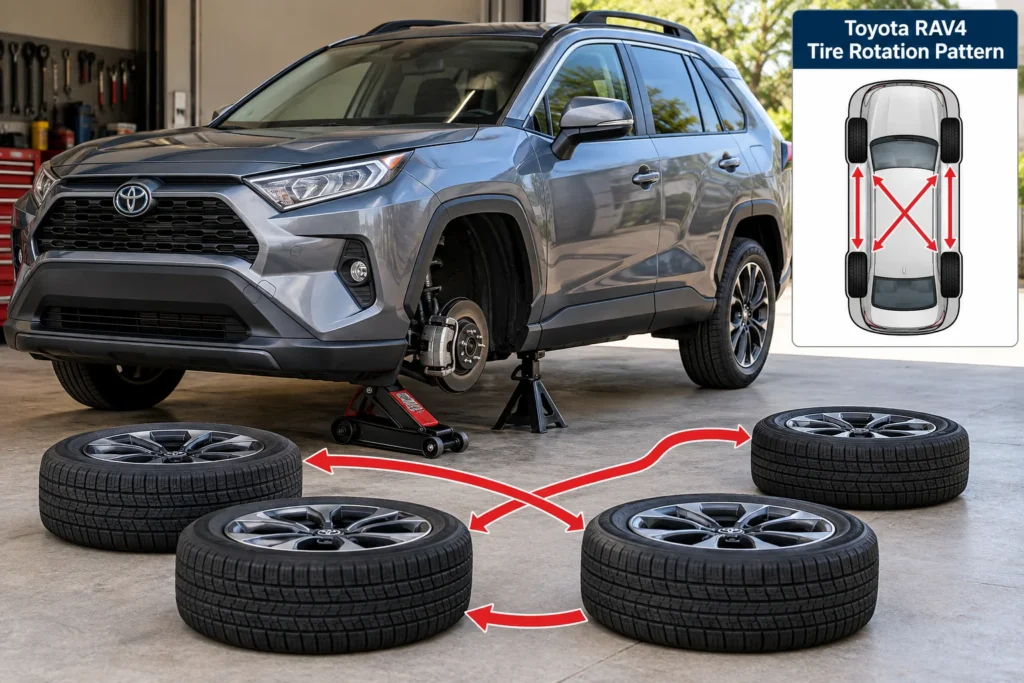
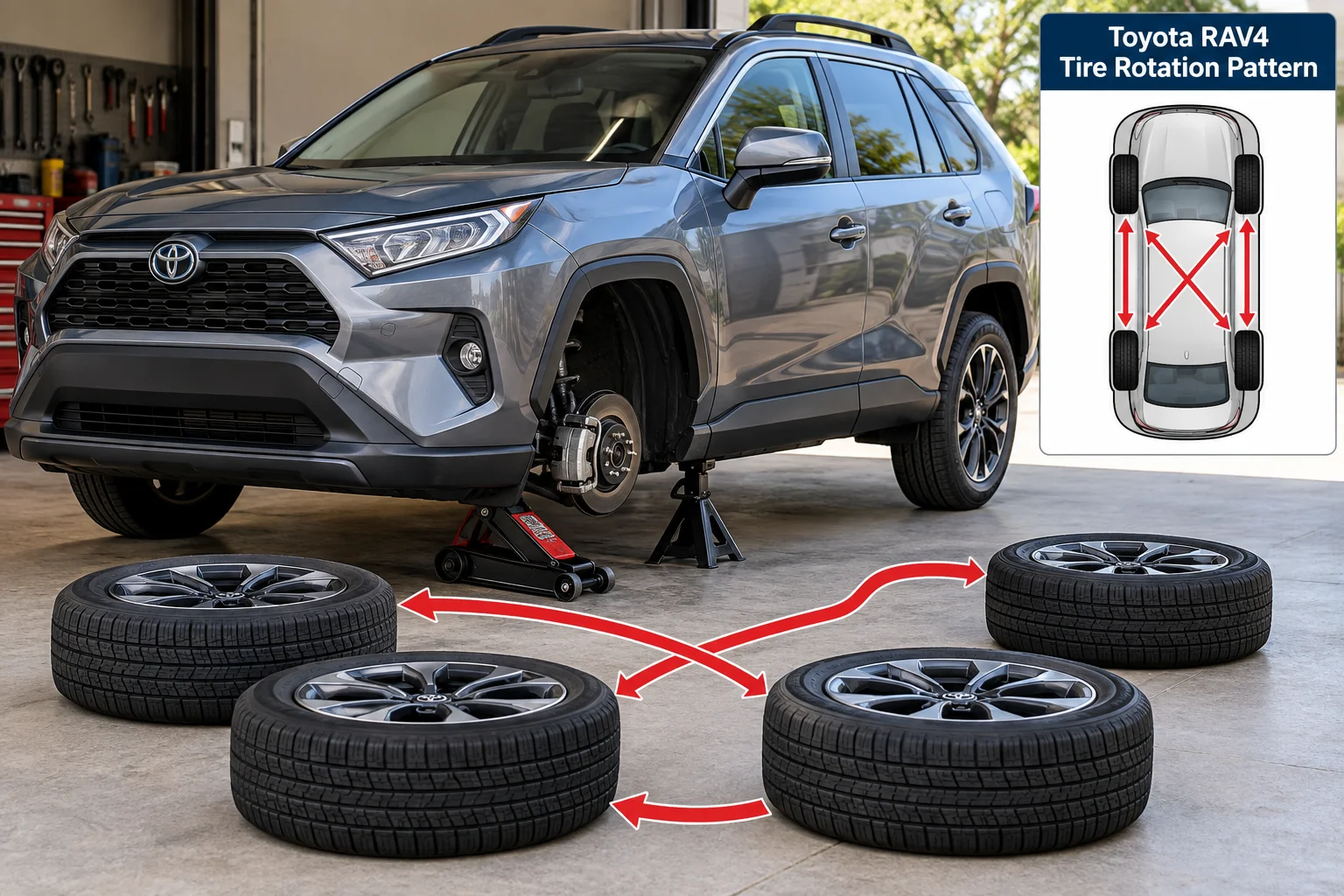
The correct Toyota RAV4 tire rotation pattern depends on the type of tires installed and the instructions provided by the tire manufacturer. A rotation is not simply a matter of moving every tire to the next wheel position. The direction and type of tire tread can determine which positions are safe for each tire.
For a standard set of non-directional tires, a common rotation approach is to move the tires diagonally between the front and rear axles. However, the correct pattern should always be confirmed against your RAV4 owner’s manual and the tire manufacturer’s requirements.
Common Tire Rotation Patterns
| Tire Type / Setup | Typical Rotation Approach | Important Note |
|---|---|---|
| Non-directional tires | Forward or rearward cross pattern may be used | Follow the vehicle and tire manufacturer’s guidance |
| Directional tires | Front-to-rear on the same side | Tire direction must remain correct |
| Same-size tires on all four wheels | Front and rear positions can generally be exchanged according to the approved pattern | Confirm the recommended pattern |
| Different front/rear tire sizes | Usually front-to-rear rotation is limited or may not be possible | Follow the vehicle manufacturer’s instructions |
| Tires with different tread designs | Pattern depends on the tire design | Never reverse a directional tire |
How a Standard Cross Rotation Works
When the tires are non-directional and the vehicle manufacturer’s instructions allow a cross rotation, the tires can be moved between axles in a pattern designed to distribute wear across all four positions.
For example, the front-left tire may move to the rear-right position, while the front-right tire may move to the rear-left position. The rear tires can then move toward the front according to the approved rotation pattern.
The important point is that the pattern should not be chosen based solely on whether the RAV4 is front-wheel drive or all-wheel drive. The tire design, wheel configuration, and manufacturer’s instructions also matter.
Directional Tires Need Extra Attention
Directional tires have tread patterns designed to rotate in a specific direction. These tires normally have markings on the sidewall indicating the required direction of rotation.
Because of this design, a directional tire should not simply be crossed to the opposite side of the vehicle if doing so would make the tire rotate backward. In many cases, directional tires are moved from the front axle to the rear axle on the same side.
If you’re unsure whether your RAV4 has directional tires, check the sidewall for directional arrows or markings and follow the tire manufacturer’s instructions.
Before Rotating the Tires
Before moving any tire, check:
- Tire size and specification
- Tire pressure
- Tread depth
- Uneven or abnormal wear
- Cracks, cuts, bulges, or other damage
- Directional arrows or rotation markings
- Whether the front and rear tires are the same size
- Wheel and tire condition
After the tires have been repositioned, set the tire pressures according to the vehicle’s recommended specifications and verify that the tires are installed correctly.
Safety note: If your RAV4 has an unusual tire setup, different front and rear tire sizes, directional tires, or significant uneven wear, don’t assume a standard rotation pattern applies. Confirm the correct procedure before moving the wheels.
How to Rotate Toyota RAV4 Tires Step by Step
Rotating the tires on a Toyota RAV4 requires more than simply changing their positions. The vehicle needs to be parked safely, the correct rotation pattern needs to be identified, and each wheel must be secured properly after installation.
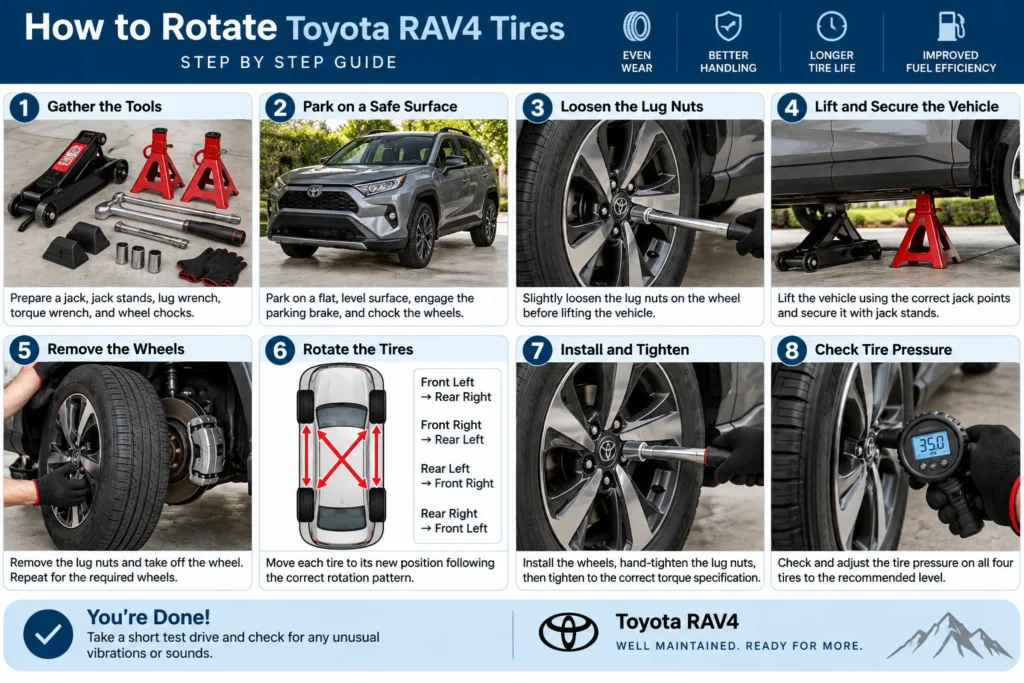
If you have the correct equipment and experience working with wheels, you can follow the general process below. If you are not comfortable lifting the vehicle or removing the wheels, having the rotation performed by a qualified tire technician is the safer option.
Step 1: Check the Tires Before Starting
Inspect all four tires before removing anything. Look for uneven tread wear, nails or other objects, cracks, sidewall damage, bulges, and unusually worn areas.
Also check whether the tires are directional and whether the front and rear wheels use the same tire size. These details determine which rotation pattern can be used.
Step 2: Park the RAV4 on a Safe, Level Surface
Park the vehicle on a firm, level surface away from traffic. Put the transmission in the appropriate park or gear position and apply the parking brake.
Turn off the engine and keep the vehicle secure before beginning work. Avoid performing wheel work on loose soil, steep slopes, or other unstable surfaces.
Step 3: Loosen the Lug Nuts
Before lifting the vehicle, slightly loosen each wheel’s lug nuts while the tires are still touching the ground.
Do not completely remove the lug nuts at this stage. Loosening them while the wheel is supported by the ground helps prevent the wheel from turning.
Step 4: Lift and Secure the Vehicle
Use a jack at the correct lifting point specified for your RAV4. Once the vehicle is raised, support it with appropriately rated jack stands before working underneath or around the vehicle.
Never rely on a hydraulic floor jack alone to support a vehicle while removing its wheels.
If you are rotating one wheel at a time, follow the safe lifting procedure recommended for your specific RAV4. A professional shop may use a vehicle lift to access all four wheels safely.
Step 5: Move the Tires According to the Correct Pattern
Remove the wheels and move them according to the approved rotation pattern for your specific tires.
For example, an approved cross pattern for non-directional tires may move the front-left tire to the rear-right position and the front-right tire to the rear-left position. Directional tires generally require a different approach so that their tread continues rotating in the correct direction.
Do not use a cross pattern simply because it is commonly recommended online. Always account for your tire design and RAV4 configuration.
Step 6: Reinstall Each Wheel
Place each wheel onto its correct hub and install the lug nuts by hand first. This helps prevent cross-threading.
Once the wheel is seated correctly, tighten the lug nuts gradually in a crisscross or star pattern rather than fully tightening one lug nut at a time.
Step 7: Lower the Vehicle Carefully
Lower the RAV4 enough for the tires to make contact with the ground and then finish tightening the lug nuts using a properly calibrated torque wrench.
Use the wheel lug nut torque specification for your exact RAV4 model year and wheel setup rather than relying on a generic torque number.
Step 8: Check Tire Pressure
After the rotation, check all four tires with an accurate tire-pressure gauge.
Set the pressure according to the vehicle’s recommended specification. The correct pressure can be found on the vehicle’s tire-information label and in the owner’s documentation.
Do not automatically use the maximum pressure printed on the tire sidewall as the vehicle’s recommended operating pressure.
Step 9: Reset or Check the TPMS
If your RAV4 is equipped with a tire-pressure monitoring system, check the dashboard after the tire rotation.
Depending on the model year and system configuration, the vehicle may require a TPMS reset, initialization, or registration procedure after tire positions are changed. Follow the instructions for your specific RAV4 rather than assuming every model uses the same procedure.
Step 10: Perform a Final Inspection
Before driving normally, confirm that:
- All four wheels are properly installed.
- Lug nuts have been tightened to the correct specification.
- Tire pressures are correct.
- Directional tires are facing the correct direction.
- No tire has visible damage.
- The TPMS system shows no warning.
- No tools or equipment remain under the vehicle.
After a short, low-speed drive, pay attention to unusual vibration, pulling, or other changes in handling. If anything feels abnormal, stop and have the wheels and tires inspected.
Toyota RAV4 Tire Rotation vs. Wheel Alignment
Tire rotation and wheel alignment are two different maintenance services, although both can affect how your Toyota RAV4’s tires wear. Rotating the tires changes their positions on the vehicle, while a wheel alignment checks and adjusts the angles of the wheels according to the vehicle manufacturer’s specifications.
Understanding the difference is important because rotating a tire cannot correct an alignment problem. If your RAV4 has abnormal wear caused by incorrect wheel angles, simply moving the tires to different positions may spread the problem rather than fix its underlying cause.
Tire Rotation vs. Alignment
| Maintenance Service | What It Does | When It May Be Needed |
|---|---|---|
| Tire Rotation | Changes the position of the tires on the vehicle | Routine tire maintenance and wear distribution |
| Wheel Alignment | Checks and adjusts wheel alignment angles | Uneven wear, steering concerns, or after certain impacts/repairs |
| Wheel Balancing | Corrects weight imbalance in the wheel/tire assembly | Vibration or balance-related symptoms |
| Tire Pressure Check | Ensures tires are inflated to the recommended pressure | Regularly and whenever pressure changes |
Why Alignment Matters for Tire Wear
A wheel that is not aligned correctly can cause a tire to wear more heavily on one edge or develop an unusual tread pattern. The problem may become more noticeable over time, particularly if the vehicle has encountered a pothole, curb impact, or other road hazard.
If you notice that the inside or outside edge of one tire is wearing much faster than the center or the opposite tire, don’t assume that a normal rotation will solve it. The vehicle should be inspected to identify the cause.
Signs Your RAV4 May Need More Than a Tire Rotation
Pay attention to symptoms such as:
- Uneven wear across one or more tires
- Vehicle pulling to one side
- Steering wheel not appearing centered while driving straight
- Steering or handling that feels different from normal
- Vibration at certain speeds
- Repeated or unusually rapid tire wear
- Tire damage after hitting a pothole or curb
These symptoms can have several possible causes, so they should not automatically be attributed to wheel alignment. Tire pressure, wheel balance, suspension components, tire condition, and road impacts can also contribute.
Rotation Does Not Fix Damaged Tires
A tire that has a bulge, serious sidewall damage, exposed cords, or severe tread deterioration should not simply be moved to another wheel position. Rotation is intended to redistribute normal tire wear; it is not a repair for a damaged or unsafe tire.
If you find significant damage during a tire inspection, have the tire assessed by a qualified tire professional before continuing to drive.
Keep the Two Services in Your Maintenance Routine
For a well-maintained RAV4, tire rotation, pressure checks, tire inspections, and appropriate alignment or balance checks all serve different purposes. Regularly checking the condition of the tires makes it easier to identify problems before they result in premature tire replacement or reduced driving safety.
Toyota RAV4 Uneven Tire Wear: Causes and Solutions
Uneven tire wear is one of the clearest signs that your Toyota RAV4 needs a closer tire inspection. Some variation in wear is normal because the front and rear tires perform different jobs, but excessive or unusual wear can indicate an incorrect tire pressure, alignment issue, wheel imbalance, suspension problem, or another mechanical concern.
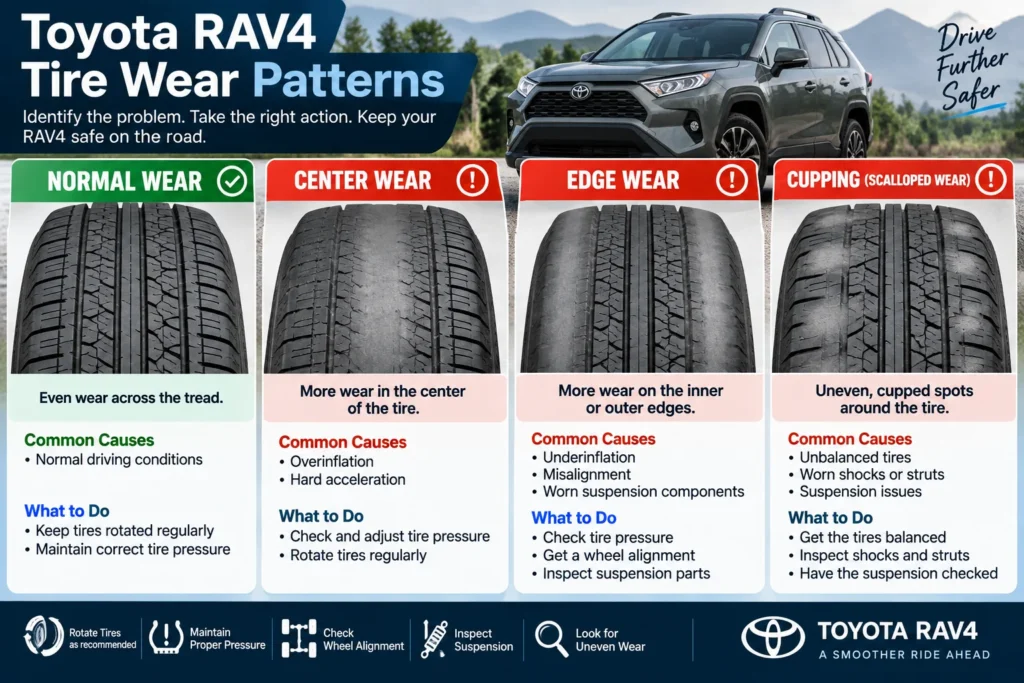
Regular Toyota RAV4 tire rotation can help distribute normal wear more evenly, but rotation should not be considered a cure for an underlying problem. If the same type of abnormal wear continues after rotation, the cause should be identified before the tires wear out prematurely.
Common RAV4 Tire Wear Patterns
| Wear Pattern | Possible Cause | What to Check |
|---|---|---|
| Both edges worn | Tire may have been operated underinflated | Tire pressure and tire condition |
| Center of tread worn | Tire may have been overinflated | Recommended tire pressure |
| One shoulder worn | Possible alignment or suspension issue | Alignment and suspension |
| Inside edge worn | Possible alignment-related wear | Wheel alignment and suspension |
| Outside edge worn | Possible alignment, cornering, or pressure issue | Alignment, pressure, driving conditions |
| Cupping or scalloped wear | Possible balance or suspension problem | Wheel balance and suspension |
| One tire wearing much faster | Tire, pressure, alignment, or mechanical issue | Full tire and vehicle inspection |
Check Tire Pressure First
Incorrect tire pressure is one of the simplest things to check when unusual wear appears. Tires should be maintained at the pressure recommended for your specific RAV4 rather than using the maximum pressure printed on the tire sidewall.
Check pressure when the tires are cold whenever possible, and inspect them regularly because pressure can change with temperature and normal air loss.
Look for Alignment-Related Wear
If the tread is wearing primarily on the inner or outer edge, the vehicle may require an alignment inspection. This does not automatically mean the alignment is the cause, but the pattern is worth investigating.
Alignment should also be considered after certain impacts, such as hitting a large pothole or curb, particularly if the vehicle develops a steering or handling change afterward.
Inspect the Suspension and Wheels
Persistent uneven wear can sometimes be associated with components beyond the tires themselves. Worn suspension parts, damaged wheels, or wheel-balance problems can contribute to abnormal tire wear or vibration.
This is why repeatedly rotating the tires without investigating the wear pattern may not solve the problem.
When to Stop Driving on a Tire
Do not wait for the next scheduled rotation if a tire has serious visible damage. A professional inspection is appropriate if you find:
- A sidewall bulge
- Deep cuts or cracks
- Exposed cords
- Severe tread damage
- A significant loss of air
- A damaged wheel
- Rapidly worsening uneven wear
Tire rotation is preventive maintenance, not a substitute for replacing a damaged or excessively worn tire.
How Much Does Toyota RAV4 Tire Rotation Cost?
The cost of a Toyota RAV4 tire rotation depends on where the service is performed, whether it is included with another maintenance service, and whether additional work is required. A basic rotation is generally a relatively simple tire service, but the final bill can increase if the technician identifies an alignment, balancing, tire-pressure, or tire-condition issue.
Some dealerships and tire shops may include tire rotation with other scheduled maintenance or tire purchases, while others charge for the service separately. For that reason, it is useful to ask what is included before approving the work.
What Can Affect the Cost?
| Factor | Why It Matters |
|---|---|
| Service location | Dealerships, tire shops, and independent garages may have different labor rates |
| Tire type | Directional or specialized tires may require a specific rotation procedure |
| Wheel configuration | Different front/rear sizes can affect whether a normal rotation is possible |
| Additional inspection | Uneven wear may require further diagnosis |
| Wheel balancing | May add cost if vibration or imbalance is detected |
| Wheel alignment | Additional service may be recommended if alignment-related wear is found |
| Tire replacement | Damaged or excessively worn tires may need replacement rather than rotation |
Is Tire Rotation Worth Paying For?
Regular tire rotation can help distribute normal wear and make it easier to monitor the condition of all four tires. However, the value of the service depends on the condition of the tires and the vehicle.
If a technician recommends additional services during a rotation, ask what problem was identified and why that service is necessary. For example, uneven tread wear may justify an inspection, while a simple rotation does not automatically mean that an alignment or balancing service is required.
The best approach is to treat tire rotation as one part of overall tire maintenance rather than as a standalone solution for every tire-related problem.
Toyota RAV4 Tire Rotation Checklist
Before and after a Toyota RAV4 tire rotation, a quick inspection can help identify problems that a simple tire-position change cannot fix. Use the following checklist whenever your tires are rotated or inspected.
Before Tire Rotation
- Check all four tires for visible damage.
- Look for uneven tread wear.
- Check tire tread condition and remaining tread.
- Check tire pressure.
- Confirm the tire size and configuration.
- Check whether the tires are directional.
- Look for cracks, cuts, bulges, or exposed cords.
- Inspect the wheels for visible damage.
- Check for unusual vibration or steering symptoms.
During Tire Rotation
- Use the correct rotation pattern for the tire design.
- Keep directional tires rotating in their marked direction.
- Use the correct lifting points for the RAV4.
- Secure the vehicle properly before removing wheels.
- Hand-start lug nuts to avoid cross-threading.
- Tighten lug nuts using the correct specification for the vehicle.
After Tire Rotation
- Confirm that every tire is in the intended position.
- Check all four tire pressures.
- Verify that directional tire markings are correct.
- Check the TPMS system for warnings.
- Make sure all wheels are securely installed.
- Pay attention to new vibration, pulling, or unusual handling after driving.
If the inspection reveals severe tire damage, rapid air loss, exposed cords, or significant abnormal wear, the tire should be professionally assessed rather than simply moved to another wheel position.
Conclusion
Regular Toyota RAV4 tire rotation is a simple part of tire maintenance that can help distribute normal wear more evenly across the vehicle’s four tires. The correct rotation interval and pattern depend on your specific RAV4, tire design, wheel configuration, and the recommendations provided by Toyota and the tire manufacturer.
Before rotating the tires, inspect their condition, check for uneven wear, confirm the correct rotation pattern, and make sure the vehicle is safely supported during the procedure. After installation, check tire pressure, verify the tire direction where applicable, and tighten the wheels using the correct lug nut torque specification for your RAV4.
Most importantly, don’t use tire rotation as a substitute for diagnosing a tire or vehicle problem. Uneven wear, steering changes, vibration, repeated pressure loss, or visible tire damage can indicate an issue that requires further inspection. Keeping tire rotation, pressure checks, inspections, and other recommended maintenance in your regular RAV4 routine can help you identify problems early and keep your tires in serviceable condition.
Frequently Asked Questions About Toyota RAV4 Tire Rotation
How often should you rotate Toyota RAV4 tires?
The correct tire rotation interval depends on the specific RAV4 model year, tire setup, and manufacturer’s maintenance recommendations. Check your owner’s manual for the interval applicable to your vehicle, and inspect the tires regularly for uneven wear between scheduled services.
What is the correct tire rotation pattern for a Toyota RAV4?
The correct pattern depends on the tire design and vehicle configuration. Non-directional tires may use an approved cross or forward/rearward pattern, while directional tires generally need to remain on the same side when moved between the front and rear axles. Always follow the applicable Toyota and tire-manufacturer instructions.
Can I rotate my RAV4 tires myself?
Yes, an experienced DIY owner can rotate tires with the correct equipment and safety procedures. You need a suitable jack, properly rated jack stands, appropriate tools, and a torque wrench. If you are not experienced with lifting a vehicle or installing wheels, professional service is the safer option.
Does tire rotation fix uneven tire wear?
Not necessarily. Rotation can redistribute normal wear, but it does not repair the cause of abnormal wear. Uneven wear can be related to tire pressure, alignment, wheel balance, suspension components, driving conditions, or tire damage. The underlying cause should be investigated if abnormal wear continues.
Do I need a wheel alignment after rotating RAV4 tires?
A tire rotation does not automatically require a wheel alignment. Alignment may be appropriate if the vehicle has symptoms such as abnormal tire wear, steering changes, or other indications of an alignment problem. An inspection can determine whether additional service is necessary.
Should I check tire pressure after rotating RAV4 tires?
Yes. Check all four tires after the rotation and adjust them to the pressure recommended for your specific RAV4. Tire pressure can affect handling, tire wear, and overall tire performance, so it should be checked regularly rather than only after a tire rotation.
Can directional tires be crossed during a RAV4 tire rotation?
Directional tires generally should not be crossed to the opposite side if doing so would reverse their intended direction of rotation. They are commonly moved between the front and rear positions on the same side. Check the directional arrow on the sidewall and follow the tire manufacturer’s instructions.
What should I do if my RAV4 vibrates after a tire rotation?
If your RAV4 develops a new or unusual vibration after a tire rotation, stop and check the wheels and tires rather than ignoring the symptom. Possible causes can include wheel installation issues, balance problems, tire damage, or another vehicle-related problem. Have the vehicle inspected if the vibration continues.