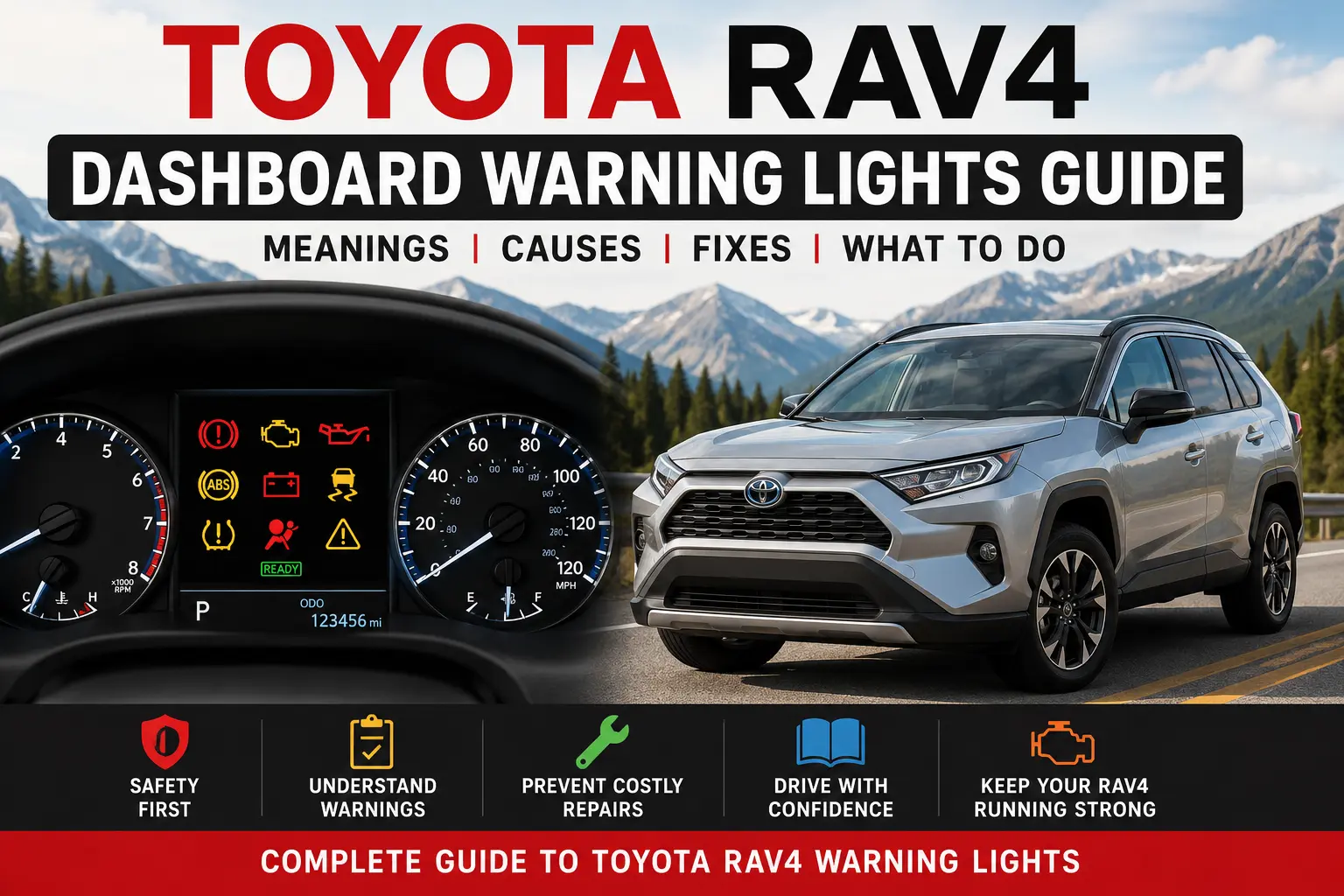
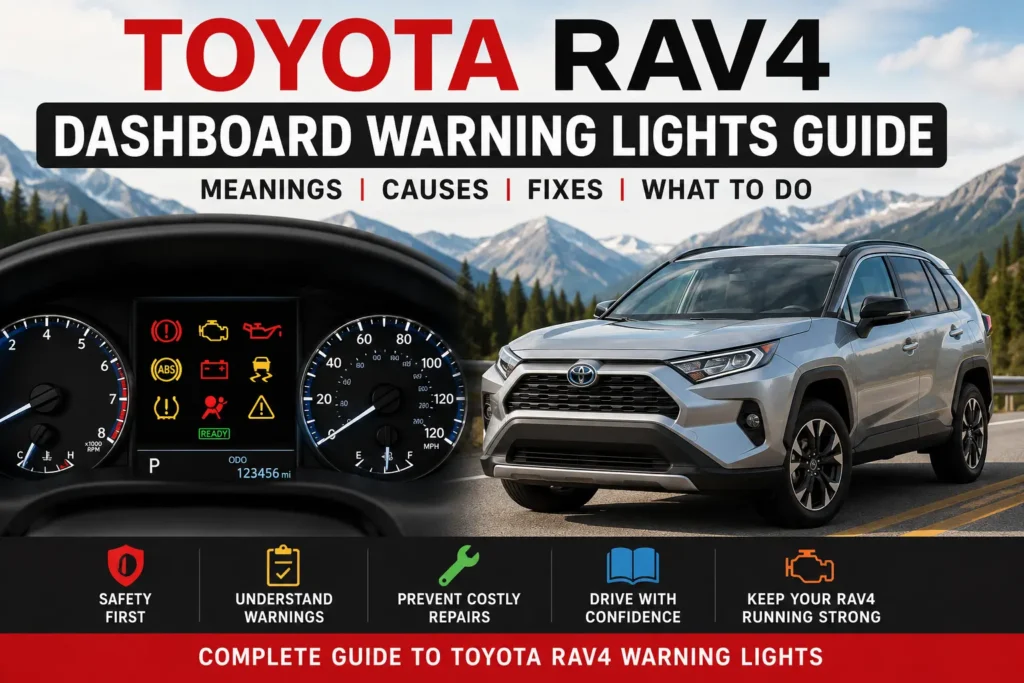
The Toyota RAV4 Dashboard Warning Lights are designed to alert drivers when the vehicle detects a problem or requires attention. While some dashboard lights simply provide information, others indicate serious issues that should be addressed immediately. Understanding what each warning light means can help you avoid expensive repairs and keep your Toyota RAV4 safe to drive.
Modern Toyota RAV4 models are equipped with advanced sensors that monitor essential systems such as the engine, brakes, battery, tires, airbags, and hybrid components. When a fault is detected, one or more Toyota RAV4 Dashboard Warning Lights will illuminate on the instrument cluster. Some lights disappear after the issue is resolved, while others require professional diagnosis and repair.
In this guide, you’ll learn the meaning of every major Toyota RAV4 Dashboard Warning Light, the possible causes behind each warning, whether it is safe to continue driving, and the recommended steps to fix the problem. This article covers both gasoline and hybrid Toyota RAV4 models, making it a complete reference for owners.
Before taking any action, it is important to understand what the Toyota RAV4 Dashboard Warning Lights are trying to tell you. Every Toyota RAV4 Dashboard Warning Lights symbol is designed to alert you about a specific system, from routine maintenance reminders to critical mechanical problems. Learning how to interpret Toyota RAV4 Dashboard Warning Lights can help you avoid expensive repairs, improve safety, and keep your RAV4 performing at its best.
Toyota RAV4 Dashboard Warning Lights Explained
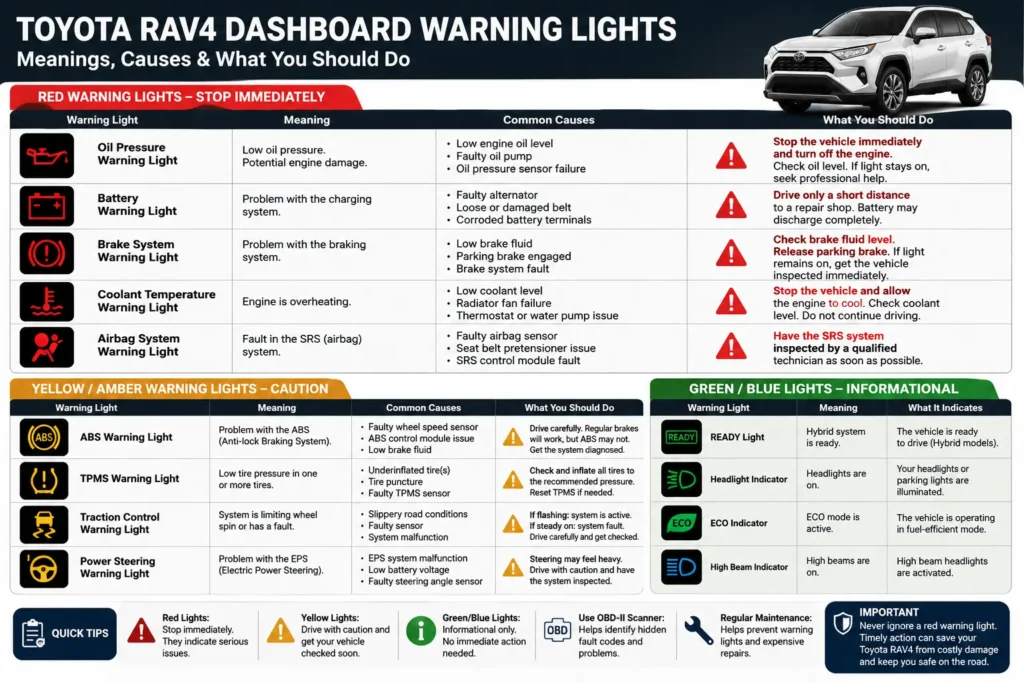
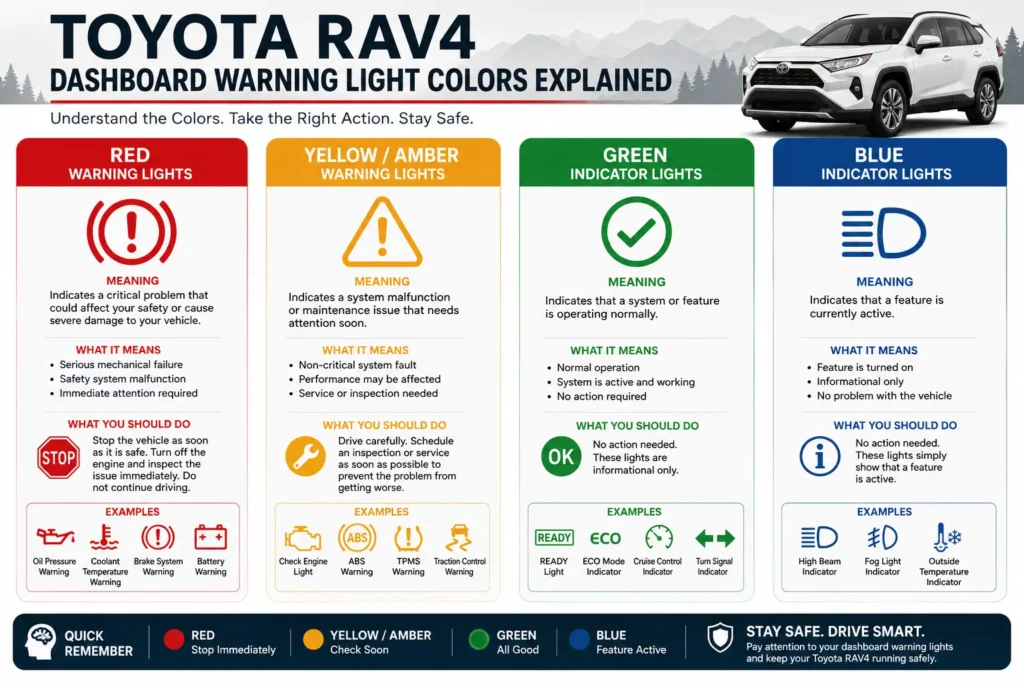
The Toyota RAV4 Dashboard Warning Lights use different colors to indicate the severity of a problem. Red warning lights usually signal an issue that requires immediate attention, yellow or amber lights indicate a system fault that should be checked soon, while green or blue lights simply inform you that a particular feature is active.
Below is a detailed explanation of the most common Toyota RAV4 dashboard warning lights, their meanings, possible causes, and what you should do when they appear.
Check Engine Warning Light
The Check Engine Warning Light is one of the most common Toyota RAV4 Dashboard Warning Lights. It indicates that the vehicle’s onboard diagnostic (OBD-II) system has detected a problem with the engine, emissions system, or related components. The light may appear as a solid yellow engine icon or begin flashing if the issue is severe.
Possible Causes:
- Loose or damaged fuel cap
- Faulty oxygen (O2) sensor
- Failing spark plugs or ignition coils
- Mass Air Flow (MAF) sensor malfunction
- Catalytic converter problems
- Engine misfire
Is It Safe to Drive?
- Solid Light: Yes, in most cases you can drive carefully, but schedule a diagnostic inspection as soon as possible.
- Flashing Light: No. Stop driving immediately if it is safe to do so, as continued driving may cause serious engine damage.
What Should You Do?
- Tighten the fuel cap and restart the vehicle.
- If the light remains on, scan the vehicle with an OBD-II scanner.
- Repair the faulty component as soon as possible.
- If the light flashes or the engine runs roughly, have the vehicle towed to a qualified repair shop.
Master Warning Light
The Master Warning Light is a general alert that indicates your Toyota RAV4 has detected one or more system warnings. It usually appears as a yellow or red triangle with an exclamation mark and is often accompanied by a message on the multi-information display explaining the issue.
Possible Causes:
- Low engine oil level
- Low coolant level
- Hybrid system warning (Hybrid models)
- Door, hood, or liftgate not fully closed
- Low fuel level
- Other active warning messages
Is It Safe to Drive?
It depends on the message displayed on the instrument cluster. If the warning relates to engine overheating, low oil pressure, or the hybrid system, stop driving immediately. For less critical alerts, you can usually continue driving carefully while arranging service.
What Should You Do?
- Read the message displayed on the dashboard.
- Resolve simple issues such as closing doors or refueling.
- If the warning indicates a mechanical problem, inspect the vehicle or visit a Toyota service center.
- Never ignore a red Master Warning Light.
Oil Pressure Warning Light
The Oil Pressure Warning Light is one of the most critical Toyota RAV4 Dashboard Warning Lights. It indicates that the engine oil pressure has dropped below the safe operating level. Driving with low oil pressure can cause severe engine damage within minutes.
Possible Causes:
- Low engine oil level
- Worn or failing oil pump
- Clogged oil filter
- Oil pressure sensor failure
- Internal engine wear
Is It Safe to Drive?
No. If this red warning light appears while driving, pull over as soon as it is safe to do so and switch off the engine immediately. Continuing to drive may result in complete engine failure.
What Should You Do?
- Stop the vehicle safely and turn off the engine.
- Check the engine oil level using the dipstick.
- Add the recommended engine oil if the level is low.
- If the warning light stays on, do not restart the engine. Have the vehicle inspected by a qualified mechanic.
Battery Warning Light
The Battery Warning Light indicates a problem with the vehicle’s charging system rather than the battery itself. It usually means the battery is no longer being charged properly while the engine is running.
Possible Causes:
- Weak or failing battery
- Faulty alternator
- Loose or damaged drive belt
- Corroded battery terminals
- Damaged charging system wiring
Is It Safe to Drive?
Only for a short distance. The vehicle may continue running until the battery is completely discharged. Once the battery loses power, the engine may stall and fail to restart.
What Should You Do?
- Turn off unnecessary electrical accessories.
- Drive to the nearest repair shop if it is safe.
- Inspect the battery terminals for corrosion.
- Have the alternator and charging system tested as soon as possible.
Brake Warning Light
The Brake Warning Light alerts you to a problem with the braking system. It may also illuminate if the parking brake is still engaged.
Possible Causes:
- Parking brake engaged
- Low brake fluid level
- Worn brake pads
- Brake hydraulic system fault
- ABS-related braking issue
Is It Safe to Drive?
Use extreme caution. If the light remains on after releasing the parking brake, your braking performance may be reduced. Have the vehicle inspected immediately.
What Should You Do?
- Confirm that the parking brake is fully released.
- Check the brake fluid level.
- Avoid high-speed driving.
- Schedule brake system inspection without delay.
ABS Warning Light
The ABS Warning Light indicates a problem with the Anti-lock Braking System (ABS). Although your regular brakes will usually continue to work, the ABS feature may not function during emergency braking, increasing the risk of wheel lock-up on slippery roads.
Possible Causes:
- Faulty wheel speed sensor
- Damaged ABS control module
- Broken ABS wiring
- Low brake fluid
- Blown ABS fuse
Is It Safe to Drive?
Yes, but with caution. Normal braking is usually available, but the anti-lock braking function may be disabled. Drive carefully and avoid sudden braking until the issue is repaired.
What Should You Do?
- Drive cautiously and maintain a safe following distance.
- Check the brake fluid level.
- Scan the ABS system for diagnostic trouble codes.
- Schedule an inspection to restore full braking performance.
Tire Pressure Monitoring System (TPMS) Warning Light
The TPMS Warning Light alerts you when one or more tires have low air pressure. Proper tire pressure improves fuel economy, handling, tire life, and overall driving safety.
Possible Causes:
- One or more underinflated tires
- Sudden tire puncture
- Seasonal temperature changes
- Faulty TPMS sensor
- TPMS system malfunction
Is It Safe to Drive?
Usually yes, but inspect the tires immediately. Driving with low tire pressure for an extended period can lead to poor handling, uneven tire wear, and even tire failure.
What Should You Do?
- Check the air pressure of all four tires.
- Inflate the tires to the recommended PSI shown on the driver’s door sticker.
- Inspect the tires for nails, punctures, or leaks.
- Reset the TPMS after correcting the tire pressure.
- If the warning remains on, have the TPMS sensors inspected.
Traction Control Warning Light
The Traction Control Warning Light indicates that the vehicle’s traction control system is actively helping maintain grip or that the system has detected a fault.
Possible Causes:
- Slippery road conditions
- Faulty wheel speed sensor
- Traction control system malfunction
- ABS-related issue
- Electronic stability control fault
Is It Safe to Drive?
Yes, in most cases. If the light flashes, the system is actively improving traction. If it stays on continuously, the traction control system may not be functioning properly.
What Should You Do?
- Reduce speed on wet or icy roads.
- Restart the vehicle to see if the warning clears.
- Check for ABS warning lights.
- Have the system diagnosed if the light remains illuminated.
Airbag Warning Light
The Airbag Warning Light indicates a problem with the Supplemental Restraint System (SRS), which includes the airbags and seat belt pretensioners. If this light stays on, the airbags may not deploy properly during a collision.
Possible Causes:
- Faulty airbag sensor
- Damaged seat belt pretensioner
- Wiring or connector issue
- Weak battery voltage
- SRS control module malfunction
Is It Safe to Drive?
Yes, but repair it as soon as possible. The vehicle can usually be driven, but the airbag system may not provide full protection in an accident.
What Should You Do?
- Restart the vehicle to check if the light clears.
- Ensure all seat belt connectors are secure.
- Avoid ignoring the warning light.
- Have the SRS system inspected by a qualified technician.
Coolant Temperature Warning Light
The Coolant Temperature Warning Light warns that the engine is overheating. This is one of the most serious Toyota RAV4 Dashboard Warning Lights because excessive engine temperature can cause permanent engine damage.
Possible Causes:
- Low coolant level
- Coolant leak
- Faulty thermostat
- Failed radiator fan
- Water pump failure
Is It Safe to Drive?
No. Stop the vehicle immediately in a safe location. Driving with an overheating engine can result in expensive engine repairs.
What Should You Do?
- Turn off the air conditioner.
- Pull over safely and switch off the engine.
- Allow the engine to cool completely.
- Check the coolant level.
- If the warning returns, have the cooling system inspected immediately.
Power Steering Warning Light
The Power Steering Warning Light indicates that the electric power steering (EPS) system has detected a fault. Steering may become heavier than normal, making the vehicle more difficult to control.
Possible Causes:
- EPS system malfunction
- Weak battery voltage
- Faulty steering angle sensor
- Damaged wiring
- Failed electric power steering motor
Is It Safe to Drive?
Drive with caution. The vehicle can usually still be driven, but steering effort may increase significantly, especially at low speeds.
What Should You Do?
- Restart the engine.
- Check the battery condition.
- Avoid unnecessary driving if steering feels unusually heavy.
- Have the EPS system diagnosed as soon as possible.
Hybrid System Warning Light (Hybrid Models)
The Hybrid System Warning Light is found on Toyota RAV4 Hybrid models. It indicates a fault in the hybrid powertrain, battery, inverter, or related electrical systems.
Possible Causes:
- Hybrid battery malfunction
- Inverter cooling system problem
- High-voltage electrical fault
- Hybrid control module issue
- Charging system failure
Is It Safe to Drive?
Not always. Some hybrid system faults allow limited driving, while others require the vehicle to be stopped immediately. Follow the message displayed on the instrument cluster.
What Should You Do?
- Read the warning message on the dashboard.
- Avoid aggressive acceleration.
- Drive directly to a Toyota service center if the vehicle operates normally.
- If the vehicle loses power or displays multiple warning lights, stop driving and arrange professional assistance.
Red vs. Yellow vs. Green Dashboard Warning Lights
Not all Toyota RAV4 Dashboard Warning Lights indicate the same level of urgency. The color of the warning light helps you understand how serious the issue is and whether you should stop driving immediately or simply schedule maintenance. Understanding these colors can help you respond appropriately and avoid unnecessary damage to your vehicle.
| Warning Light Color | Meaning | What You Should Do |
|---|---|---|
| 🔴 Red | Critical safety or mechanical problem | Stop the vehicle as soon as it is safe and inspect the issue immediately. |
| 🟡 Yellow / Amber | System malfunction or maintenance required | Drive carefully and arrange service as soon as possible. |
| 🟢 Green | System is operating normally | No action is required. The light is informational only. |
| 🔵 Blue | A feature is currently active | No repair is needed. This usually indicates high beams or another active function. |
In general, red warning lights should never be ignored, as they often indicate problems that can lead to serious engine damage or safety risks. Yellow warning lights usually allow you to continue driving for a short time, but they should still be diagnosed promptly. Green and blue lights simply inform you that a specific system or feature is currently active.
What to Do When a Dashboard Warning Light Appears
Seeing one of the Toyota RAV4 Dashboard Warning Lights can be alarming, but taking the right steps can help prevent costly repairs and keep you safe.
Follow these recommendations:
- Stay calm and avoid sudden braking or acceleration.
- Check whether the warning light is red, yellow, green, or blue.
- Read any warning message displayed on the multi-information screen.
- If a red warning light appears, stop the vehicle as soon as it is safe.
- Inspect basic items such as the engine oil level, coolant level, brake fluid, and tire pressure if applicable.
- Do not ignore flashing warning lights, especially the Check Engine Light.
- Use an OBD-II scanner to identify diagnostic trouble codes when possible.
- If the cause cannot be identified, have the vehicle inspected by a certified Toyota technician.
Following these steps can help you prevent expensive repairs, reduce the risk of breakdowns, and ensure your Toyota RAV4 continues to operate safely and reliably.
Conclusion
Understanding the Toyota RAV4 Dashboard Warning Lights can help you identify problems early, prevent expensive repairs, and drive with greater confidence. While some dashboard lights simply provide information, others warn of serious issues that require immediate attention. Knowing the difference can protect both your vehicle and your safety.
Always pay attention to warning lights as soon as they appear. Check your owner’s manual, inspect basic maintenance items when appropriate, and never ignore critical warnings such as the Check Engine Light, Oil Pressure Warning Light, or Coolant Temperature Warning Light. Addressing problems early is almost always less expensive than waiting for a major repair.
By following the recommendations in this guide, you can better understand every major Toyota RAV4 Dashboard Warning Light, respond correctly when a warning appears, and keep your Toyota RAV4 running safely and reliably for years to come.
Understanding Toyota RAV4 Dashboard Warning Lights is one of the easiest ways to protect your vehicle from unexpected breakdowns and costly repairs. By recognizing Toyota RAV4 Dashboard Warning Lights early, you can take the right action before a small issue becomes a major problem. Always pay attention to Toyota RAV4 Dashboard Warning Lights, follow the recommended maintenance schedule, and consult a qualified technician whenever necessary. Keeping track of Toyota RAV4 Dashboard Warning Lights will help ensure your Toyota RAV4 remains safe, reliable, and ready for every journey.
Frequently Asked Questions
What does the Toyota RAV4 check engine light mean?
The Check Engine Light indicates that the vehicle has detected a fault related to the engine, emissions system, or another important component. A diagnostic scan is recommended to identify the exact cause.
Can I drive with a Toyota RAV4 warning light on?
It depends on the warning light. Green and blue lights are informational, while most yellow lights allow limited driving. Red warning lights usually require you to stop the vehicle immediately to avoid damage or safety risks.
What is the red triangle warning light on a Toyota RAV4?
The red or yellow triangle with an exclamation mark is the Master Warning Light. It indicates that one or more vehicle systems require your attention. Always read the message displayed on the instrument cluster for more details.
Why is my TPMS warning light still on after inflating the tires?
If the TPMS Warning Light remains illuminated after correcting tire pressure, the system may need to be reset, or one of the TPMS sensors may have failed.
Which Toyota RAV4 dashboard warning lights require immediate attention?
The most critical warning lights include:
Oil Pressure Warning Light
Coolant Temperature Warning Light
Brake Warning Light
Flashing Check Engine Light
Hybrid System Warning Light (Hybrid models)
These warnings should never be ignored because they may indicate serious mechanical or safety problems.What do Toyota RAV4 Dashboard Warning Lights mean?
Toyota RAV4 Dashboard Warning Lights indicate the condition of different vehicle systems. Some lights provide general information, while others warn of maintenance needs or serious mechanical problems. Understanding Toyota RAV4 Dashboard Warning Lights helps you respond quickly, prevent expensive repairs, and drive your Toyota RAV4 safely.